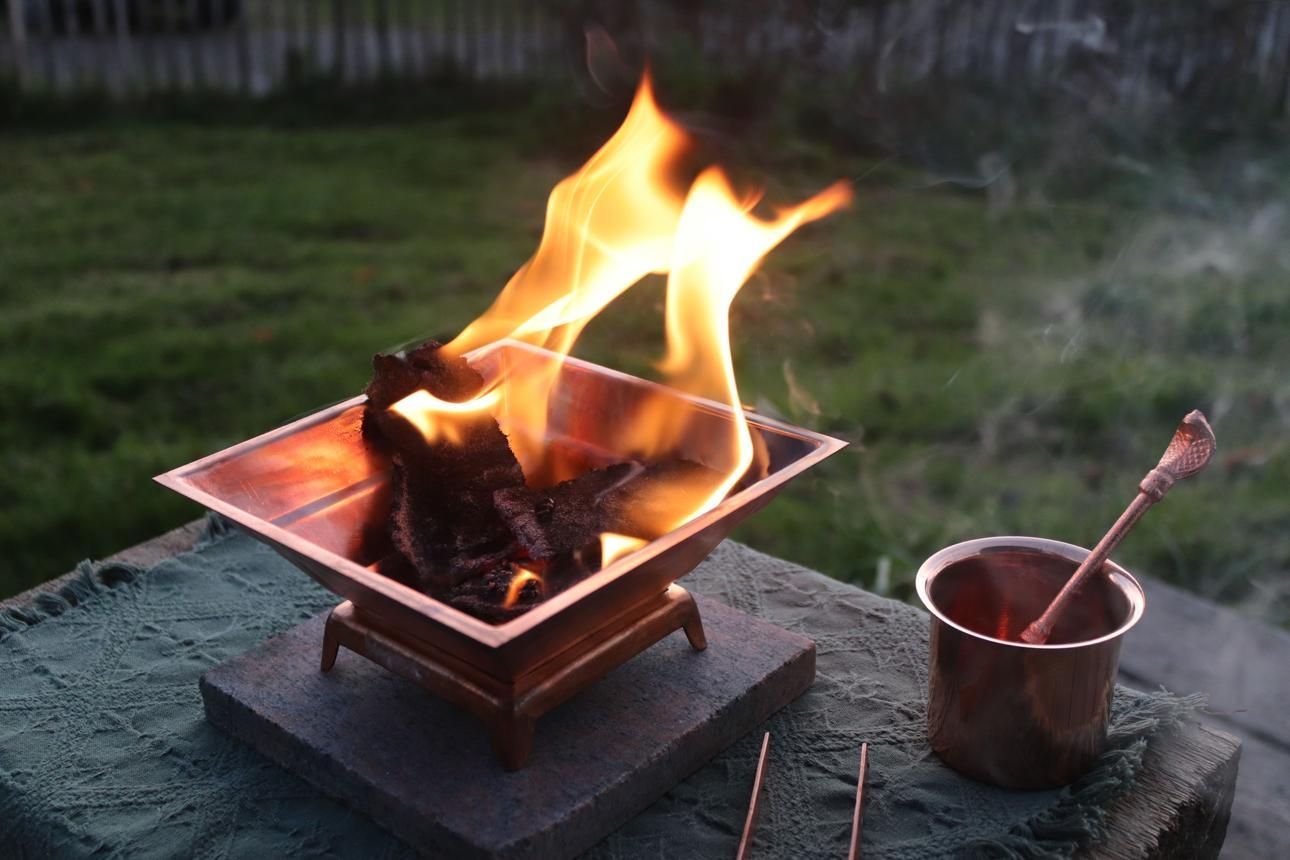
Agnihotra brings people together around a shared moment of spiritual practice. In the contemporary form followed by many groups, a small fire is prepared using dried cow dung, with offerings of rice and ghee at sunrise and sunset, accompanied by mantras. [1]
At Nilam, it offers a space for people who embrace nature, spirituality and non-violence to meet, reflect and share an interest in compassionate living.
Its traditional healing meaning is explored through spiritual reflection, personal experience and conversation. Alongside this, our learning activities introduce scientific studies investigating particular aspects of the practice and its materials.
Gratitude expressed around the fire continues in the everyday care of the cows connected with it.
Research gives us opportunities to explore traditional practices more closely. We share study material in accessible language so participants can understand what researchers investigated and what their findings mean.
A laboratory study reported reductions in cultured airborne microorganisms following a fire using several plant materials. It explored microbial changes, rather than demonstrating medical healing or the effects of cow dung alone. [2]
A field experiment with ten treatments reported favourable growth and soil nutrient results with Agnihotra ash, offering a basis for further agricultural research. [3]
These studies investigate specific environmental or agricultural outcomes; they do not establish Agnihotra as a medical treatment.